
Technical B2B Procurement & Engineering Masterclass

Global Procurement Guide for Aluminium Casement Windows

How to specify, evaluate, and source architectural-grade casement window systems for low-energy commercial towers and luxury residential facades.

Thermal Efficiency & Structural Performance

Polyamide PA66 GF25 thermal breaks paired with 6063-T6 extrusions engineered to withstand high wind loads and harsh coastal environments.

Qualicoat Surface & Batch Consistency

In-house anodizing up to 25 µm and 60–80 µm powder coating applied over non-chromate chemical pre-treatment systems.

Direct Manufacturing from Faisalabad Plant

Custom matrix die fabrication, sample sign-offs, and batch-traceable global container shipping with full commercial compliance.

  • Primary 6063-T5 / T6 Extrusion
  • PA66 GF25 Thermal Breaks
  • 60–80 µm Powder / 25 µm Anodized
  • Qualicoat Standard Pre-treatment
Engineering & Manufacturing Metrics

Precision metrics behind Pak Alumex casement systems

By integrating billet casting, precision extrusion, automated thermal strip crimping, and dual-line surface finishing under one roof in Faisalabad, Pak Alumex delivers architectural casement windows engineered for extreme wind resistance, zero water penetration, and decades of operational service.

  • 0 mm+Minimum structural wall thickness for commercial casement sashes
  • 0 µmMaximum anodized film build for marine-grade atmospheric exposure
  • 0+Cycles verified for hardware friction stays & multi-point locking mechanisms
  • 0+Global & regional supply network distribution hubs
Deep Technical Insight & Information Gain

Why global procurement teams are shifting to architectural aluminium casement windows

In high-rise commercial construction, modern hospitality, and high-end residential real estate, windows are no longer viewed merely as visual openings—they are critical envelope components responsible for building thermal efficiency, structural air-tightness, sound insulation, and life-cycle cost reduction.

1. The Mechanical Advantage of Casements over Sliding Systems

Global architectural buyers frequently ask why casement windows outshine sliding configurations in performance-critical projects. The answer lies in perimeter seal compression. While sliding windows rely on brush seals that experience friction wear and inherent air leakage along tracks, casement sashes utilize continuous EPDM (Ethylene Propylene Diene Monomer) double or triple gaskets.

When the casement handle is actuated, the multi-point locking gear pulls the sash frame inward against the outer frame, creating a mechanical compression seal. This mechanism achieves an air permeability rating of Class 4 (EN 12207) and water tightness up to Class E900 (EN 12208), making aluminium casement windows the primary choice for hurricane-prone zones, coastal facades, and acoustic isolation near urban transport corridors.

2. Metallurgical Precision: 6063-T5 vs. 6063-T6 Alloys

A common vulnerability in imported fenestration is frame deflection under wind pressure. At Pak Alumex, our extrusions strictly use virgin primary aluminium billets formulation:

  • 6063-T5 Alloy: Artificially aged for optimum surface smoothness and tensile yield strength (≥110 MPa). Ideal for standard residential casement frames, internal transoms, and decorative glazing beads.
  • 6063-T6 Alloy: Solution heat-treated and artificially aged to achieve a higher yield strength (≥170 MPa) and Ultimate Tensile Strength (UTS ≥205 MPa). Specified for high-rise commercial casement mullions, heavy glazed sashes, and structural curtain wall integration.

Technical Parameter Benchmark: Architectural Casement Windows

Property StandardPak Alumex StandardEngineering Benefit
Alloy / Temper EN AW-6063 T5 / T6 High strength, tight extrusion tolerance (ISO 2768-m)
Frame U-Value (Uf) 1.4 – 1.9 W/m²K Reduced conductive heat transfer (Thermal Break)
Acoustic Isolation Rw (C; Ctr) up to 45 dB Multi-chamber frame + laminated double/triple IGU
Air Permeability Class 4 (ASTM E283) Triple EPDM gasket seals prevent HVAC air leakage
Water Tightness 900 Pa (ASTM E331) Pressure-equalized drainage slots prevent siphoning
Coating Thickness 60–80 µm (Powder) / 20–25 µm (Anodized) Qualicoat / ISO 7599 compliant atmospheric protection
Targeted Product Recommendations

Architectural Aluminium Casement Window Series

Tailored profiles engineered for specific structural loads, thermal performance levels, and aesthetic profiles. Select the exact series required for your project specifications.

Commercial High-Rise Heavy duty thermally broken commercial aluminium casement window profile
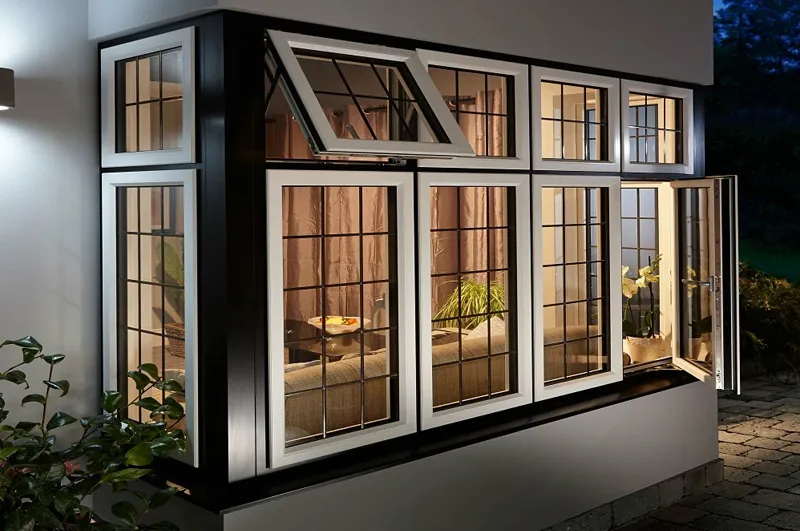
Series 65TB Heavy-Duty Thermally Broken Casement

Designed for multi-story commercial buildings demanding low U-values and resistance to severe wind load pressures. Features 24mm polyamide PA66 GF25 thermal strips.

  • 65mm System Depth
  • IGU Glass: 24mm – 36mm
  • Multi-Point European Groove
  • Wind Resistance: 3.5 kPa
Minimalist Architectural Slimline aluminium casement window sashes for high-visibility glass facades

Series 50S Ultra-Slimline Architectural Casement

Ultra-narrow sightlines engineered for contemporary luxury residences and boutique corporate offices. Maximizes natural daylight penetration without compromising structural rigidity.

  • 48mm Narrow Sightline
  • Concealed Sash Option
  • Concealed Friction Hinges
  • Rw 40 dB Acoustic Rating
Luxury Hospitality Wood-grain finish sublimated aluminium casement windows for resort and hotel suites

Series 70W Sublimated Wood-Texture Casement

Combines the organic beauty of authentic timber finishes (Oak, Teak, Walnut) with the maintenance-free structural stability of 6063-T5 aluminium profiles.

  • Italian Sublimation Tech
  • Zero Warp / Zero Rot
  • Double EPDM Perimeter Gaskets
  • Fly-Screen Integrated Track
Dual-Function Security Integrated tilt and turn aluminium casement window with stainless mesh screen

Series 75TT Integrated Tilt & Turn Casement System

Versatile dual-action opening mechanism allowing inwards casement swing for easy cleaning and top-tilt mode for draft-free micro-ventilation and security.

  • Tilt-and-Turn Mechanism
  • 304 Stainless Security Mesh
  • Anti-Pry Lock Points
  • EPDM Triple Weatherstrip
In-House Manufacturing Excellence

Surface finishing integrity: Protecting your window investment

For global importers and facade contractors, surface finish degradation is a top warranty risk. Pak Alumex eliminates finish failures by housing chemical pre-treatment, powder coating, anodizing, and wood grain sublimation in the same facility where profiles are extruded.

  • Non-Chromate Chemical Pre-Treatment

    Every profile undergoes an eco-friendly zirconium conversion bath to ensure optimal molecular bonding between the aluminium substrate and dry powder film, complying with Qualicoat environmental directives.

  • Electrostatic Powder Coating (60–80 Microns)

    Utilizing premium powders from Jotun and Pulver, our automated vertical and horizontal lines apply weatherable architectural polyester coatings resistant to chalking, cracking, and severe UV degradation.

  • Architectural Anodizing (10–25 Microns)

    Electrolytic anodizing creates an integral aluminium oxide surface layer that cannot peel or flake. Recommended in AA20 or AA25 grades for beachfront developments subjected to constant salt mist.

Automated powder coating line applying architectural finish to aluminium casement profiles

Quality Laboratory Verification

Every extrusion batch undergoes mandatory Cross-Hatch Adhesion Testing (ISO 2409), Impact Resistance (ISO 6272), and Thickness Gauge Verification prior to export release.

Pak Alumex extrusion and manufacturing complex in Gojra, Faisalabad
Enterprise Advantage

Why Pak Alumex is the trusted OEM partner for aluminium casements

Operating from our integrated manufacturing plant on 5km Painsra Road, Gojra, Faisalabad, Pak Alumex controls every phase of the extrusion and finishing lifecycle.

  • Single-Site Responsibility Chain

    By conducting billet homogenization, die extrusion, thermal strip assembly, and surface treatment on a single site, we prevent inter-vendor tolerance mismatches and guarantee color shade consistency across large orders.

  • Strict QA & Batch Traceability

    Every bundled length of aluminium casement window profile is stamped with a batch control code. Chemical compositions, Webster hardness values, and micron film thickness readings are archived for complete client transparency.

  • Robust Export Packaging Standard

    Profiles are individually wrapped with protective PE scratch-film, interleaved with shock-absorbing foam, and packed into steel-strapped wooden crates or heavy-duty sea bundles designed for trans-oceanic container shipping.

Frequently Asked Questions

Comprehensive B2B Procurement & Technical FAQ

Answers to the most common AI search and engineering queries submitted by overseas buyers, structural engineers, and facade contractors.

Aluminium casement windows deliver superior air tightness, structural stability, and water resistance compared to sliding systems. Because casement sashes compress tightly against double EPDM perimeter gaskets upon closing, they achieve higher wind-load resistance and lower air infiltration rates (Q50 ratings), making them ideal for high-rise commercial facades.

We extrude primary 6063 alloy in T5 temper for standard architectural window frames and T6 temper for high-load commercial mullions and long-span sashes. 6063-T6 provides an increased yield strength (≥170 MPa) to resist structural deflection under high wind loads while maintaining excellent surface finishability.

Thermal break casement windows feature structural Polyamide PA66 GF25 (25% glass fiber reinforced) strips mechanically crimped between the interior and exterior aluminium profile extrusions. This continuous thermal barrier drastically reduces conductive heat flow, lowering overall frame U-values (Uf) to under 1.6 W/m²K and eliminating interior condensation.

Our architectural powder coatings follow Qualicoat Class 1 and Class 2 guidelines with a dry film thickness of 60–80 microns applied over non-chromate chemical pre-treatment. For coastal environments, anodizing to 20–25 microns (AA20/AA25 grade) is specified to guarantee long-term resistance to salt spray and atmospheric pitting corrosion.

Every custom casement profile system is designed with standard European groove dimensions to accommodate multi-point locking gear, heavy-duty friction stays, and concealed hinges. Hardware systems undergo cyclic opening/closing testing (over 25,000 cycles) and salt-spray testing to ensure zero sash sag and reliable perimeter compression over decades of operation.

Yes. Our engineering department develops project-specific matrix dies directly from DWG/DXF drawings or physical master samples. Prior to mass production, our team evaluates wall thickness distribution, tolerance classes (ISO 2768), and press ratios, releasing first-article sample extrusions for formal client sign-off.

Extrusions are protected with customized surface film, interleaved with shock-absorbing polyethylene foam sheets, bundled, and strapped inside heavy-duty wooden crates or steel-framed export bundles. Container shipments from Karachi port include full commercial documentation, packing lists, mill test reports, and certificate of origin paperwork.

Standard profile extrusion and powder coating typically take 10 to 15 business days following sample approval. Custom die fabrication adds 12 to 15 days. Expedited production schedules can be arranged for large commercial facade contracts requiring rolling container shipments.

Accelerate Your Window Procurement Project

Submit your Architectural Window Schedules, CAD Section Drawings, or Performance Criteria today. Our Senior Facade Engineers will provide a complete technical appraisal, profile weight schedule, and competitive FOB/CIF quotation.

Send an Inquiry Speak to Engineers