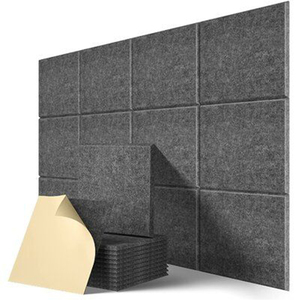
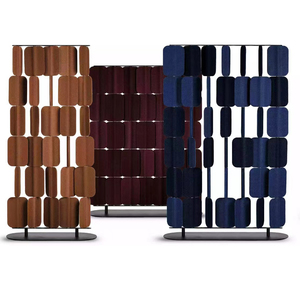
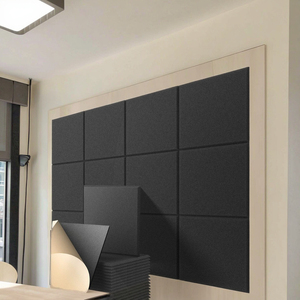
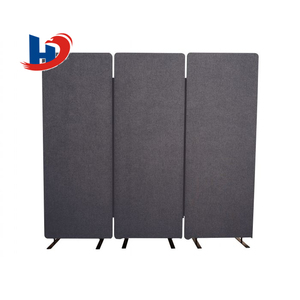
100% PET Felt Polyester Fiber Acoustic Insulation Panels Soundproof Wall & Partition Divider For Hotel Application
- NRC Rating: 0.85 – 0.90
- Material: 100% Recycled PET Felt
- Fire Class: EN 13501-1 Class B-s1,d0
Engineered for commercial offices, luxury hospitality, educational facilities, and studio environments requiring certified sound attenuation (STC 32 to 58 dB) and high Noise Reduction Coefficients (NRC up to 0.95).
Modern commercial architecture demands a delicate balance between open-plan aesthetics and strict acoustic privacy standards. As a premier CE Certified Acoustic Partitions Supplier & Exporters, our manufacturing methodology integrates advanced physical acoustic principles with European Harmonized Standards. Acoustic partitions serve two fundamental acoustic functions: airborne sound attenuation (measured via Sound Transmission Class, STC, or Weighted Sound Reduction Index, R_w) and reverberation control (measured via Noise Reduction Coefficient, NRC, or Sound Absorption Class according to EN ISO 11654).
Compliance with the European CE Mark (specifically EN 13964 for suspended and ceiling-mounted acoustic structures and EN 14351-1 for internal operable partition wall assemblies) requires rigorous laboratory validation. Every batch of our polyester fiber (PET) sound absorbing felt and mechanical operable wall systems undergoes continuous quality audits, verifying structural stability, flexural tensile strength, formaldehyde safety (E0 Class under EN 717-1), and reaction to fire performance.
To assist architectural specifiers, acoustic consultants, and general contractors in procurement evaluation, the following technical dataset highlights our certified partition performance characteristics across primary core materials:
| Partition Core Material | Nominal Density | Acoustic Rating (STC / R_w) | Sound Absorption (NRC) | Fire Reaction Rating | Primary CE Standard |
|---|---|---|---|---|---|
| 100% High-Density PET Felt | 1900g – 2400g/m² | STC 32 – 36 dB (Single Layer) | 0.85 – 0.95 (EN ISO 354) | EN 13501-1 Class B-s1, d0 | EN 13964:2014 Annex ZA |
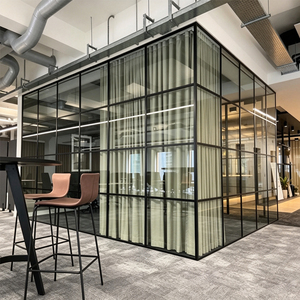
| Double Glazed PVB Laminated Glass | 28 kg/m² frame mass | STC 45 – 52 dB (Dual Sealed) | 0.15 – 0.25 (Reflective) | EN 13501-1 Class A1 Non-Combustible | EN 14351-1:2006+A2:2016 |
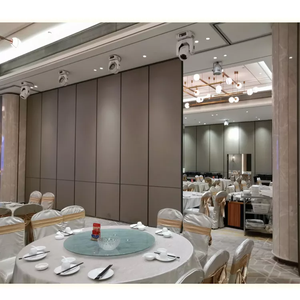
| Automated Operable Timber Wall | 38 kg/m² composite | STC 50 – 58 dB (Mechanical Seal) | 0.65 – 0.75 (Slotted Surface) | BS 476 Part 7 Class 1 / EN 13501 B | EN 14351-1 / Machinery Directive |
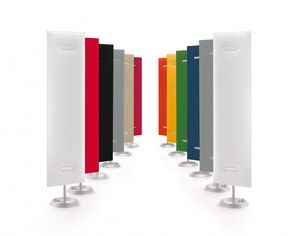
| 3D Embossed Free-Standing PET | 1600g – 2000g/m² | STC 28 – 32 dB (Screen Barrier) | 0.80 – 0.90 (Diffusion Core) | EN 13501-1 Class B-s1, d0 | EN 13964 / REACH Compliant |
The global commercial real estate and workplace design landscape is undergoing a structural transition toward flexible, sustainable, and technology-integrated interior environments. B2B purchasers, corporate interior contractors, and international import partners must align their supply chain strategies with these emerging procurement drivers:
Global architectural specifications now prioritize products with verified Environmental Product Declarations (EPD) and Health Product Declarations (HPD). The shift toward 100% post-consumer recycled polyethylene terephthalate (rPET) derived from plastic bottle waste drastically reduces embodied carbon while earning LEED v4.1 and BREEAM credits.
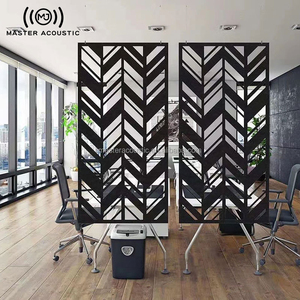
Fixed partition walls are being replaced by tool-free free-standing dividers, sliding operable acoustic doors, and track-mounted hanging screens. Corporate tenants demand spatial reconfigurability that allows multi-purpose halls, training rooms, and private executive spaces to be transformed in minutes without structural demolition.
Acoustic performance must blend seamlessly with natural visual design. Slat-wood acoustic panels (Akupanel) combining real wood veneers (Oak, Walnut, Teak) bonded to sound-absorbing PET felt are experiencing exponential demand, fulfilling both psychoacoustic noise damping and human-centric biophilic design goals.
Advancements in non-woven textile engineering and precision mechanical hardware have elevated soundproof partition performance to unprecedented levels. As leading exporters, our R&D focus is anchored on four core material and mechanical innovations:
As a vertically integrated manufacturer and international exporter, we provide global B2B clients, architectural distributors, and OEM brand partners with distinct supply chain advantages that eliminate project delivery risks:
We control the raw fiber blending, needle-punching, thermal bonding, and CNC panel cutting lines under one continuous Quality Management System, maintaining tight batch-to-batch color and density consistency.
From custom beveling, V-grooving, 3D thermoforming, and laser-engraved corporate logos to project-specific track profiles and hardware anodizing, we engineer bespoke acoustic solutions tailored to exact drawing specifications.
International shipments receive export-grade fumigated wooden crating, plastic film interleaving, and corner edge-protectors to prevent moisture ingress, scuffing, or structural flex during container transit.
Sound Transmission Class (STC) measures the ability of a building partition wall or door to block airborne sound transmission between adjacent rooms (sound isolation, measured in decibels dB). In contrast, Noise Reduction Coefficient (NRC) measures the percentage of sound energy absorbed by a material surface within a room (sound absorption, rated from 0.00 to 1.00). Operable banquet walls require high STC ratings (50+ dB) to block room-to-room noise, whereas open-office dividers require high NRC ratings (0.85+) to control reverberation and echo.
Our PET acoustic panel series complies with CE EN 13964:2014 (Suspended Ceilings and Interior Wall Finishes Requirements), validating dimensional stability, mechanical resistance, and non-toxicity. Our glass and operable partition wall systems comply with CE EN 14351-1. Full Declaration of Performance (DoP) documentation, factory production control certificates, and third-party laboratory test reports are provided with commercial shipping invoices.
Our 100% polyester fiber acoustic panels achieve EN 13501-1 Class B-s1, d0 (indicating very limited contribution to fire, minimal smoke emission, and zero flaming droplets). They also pass ASTM E84 Class A testing for North American architectural specifications. Wooden finish operable walls are treated with fire-retardant intumescent cores compliant with BS 476 Part 7 Class 1 standards.
Yes. We support full OEM manufacturing. Standard panel thicknesses range from 9mm, 12mm, 15mm, to 24mm, with densities customizable from 1300g/m² up to 3000g/m². For project orders exceeding 500 square meters, we offer custom dye-matching to exact RAL or Pantone color references, as well as bespoke CNC grooving and 3D surface beveling.
Standard export order production lead time is 12 to 18 working days from CAD shop drawing sign-off. Products are packed in moisture-proof PE wraps and heavy-duty corrugated cartons, or reinforced plywood crates for glass/operable walls. PET acoustic panels are typically exported under HS Code 3926.9090 or HS Code 5602.2900 depending on destination customs classification.
Sound travels through the smallest air gaps (flanking paths). Our movable walls incorporate double-lip flexible magnetic EPDM gaskets between interlocking aluminum panel profiles, combined with top and bottom expandable mechanical pressure seals that exert up to 2.5 kN of sealing force against floor and ceiling tracks when locked in position.

Connect directly with our engineering team for detailed CAD drawings, CE Declaration of Performance (DoP) documents, physical acoustic sample kits, and competitive FOB/CIF export quotations.